
The cable running above your ceiling is invisible for exactly one reason: somebody chose correctly before the drywall went up. Choose cheaply and every video call, camera dropout and printer offline report for the next decade blames the network first.
Structured cabling starts with copper categories, and the numbers mean bandwidth. Cat 5e carries signals up to 100 MHz and handles gigabit over short runs; it is still the right call for basic voice drops and legacy equipment. Cat 6 holds tighter specifications for crosstalk and noise and runs gigabit comfortably, with 10-gigabit possible on short office distances; it has become the practical default. Cat 6a doubles the frequency headroom to 500 MHz, kills the alien crosstalk problem that plagues dense 10-gigabit bundles, and is what we recommend for new installations that should not have to be re-pulled in five years.
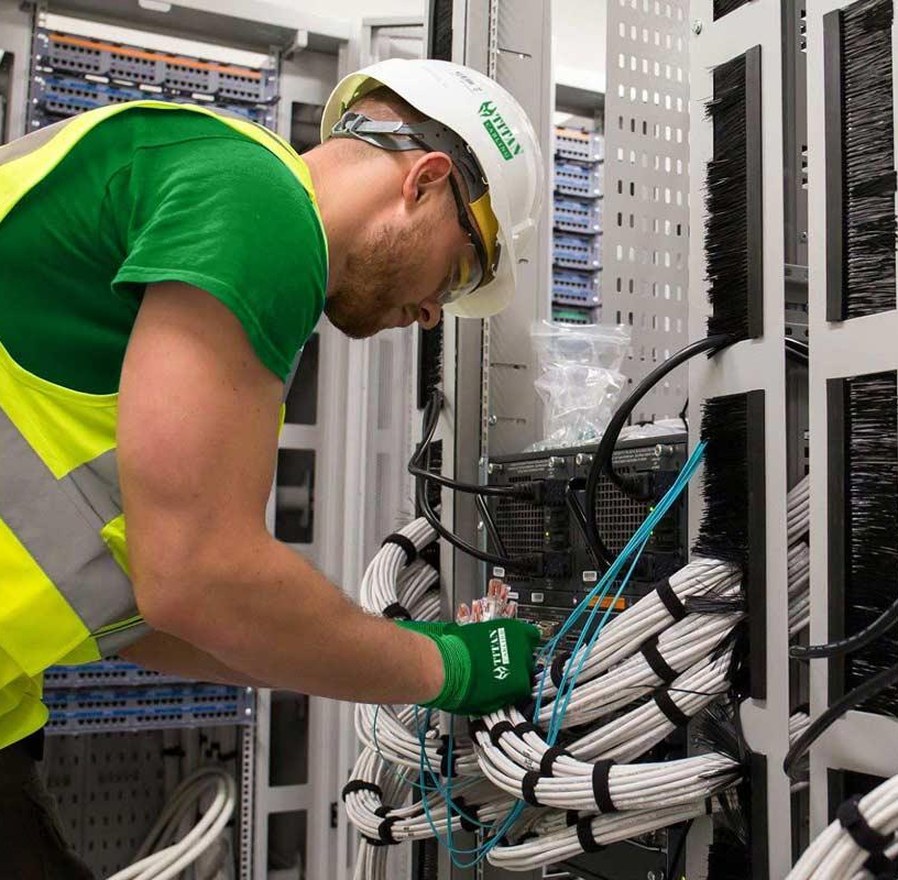
The category choice is only half the job. Everything that makes a network trustworthy is the boring half: cable racks mounted securely, patch panels labeled at both ends, vertical and horizontal wire management that keeps bend radii honest, and abandoned cable removed instead of left above the ceiling tiles the way the National Electric Code already said not to. A tidy closet is not vanity; it is the reason the next technician can find a circuit in ninety seconds instead of a day.
One modern note: data cabling now carries power too. PoE runs cameras, wireless access points, door controllers and VoIP phones over the same wire that carries their network, which is exactly why the 6a recommendation keeps maturing into the smart default. Power budgeting becomes part of the design conversation, not a surprise later.
Whatever your office looks like now, there is a version of this conversation that costs money before the drywall and a version that costs more money after it. The cable in the wall is the cheapest decision in the whole building.